

Dutch Licensed Gambling Market Shrinks as Online Revenue Falls 21%
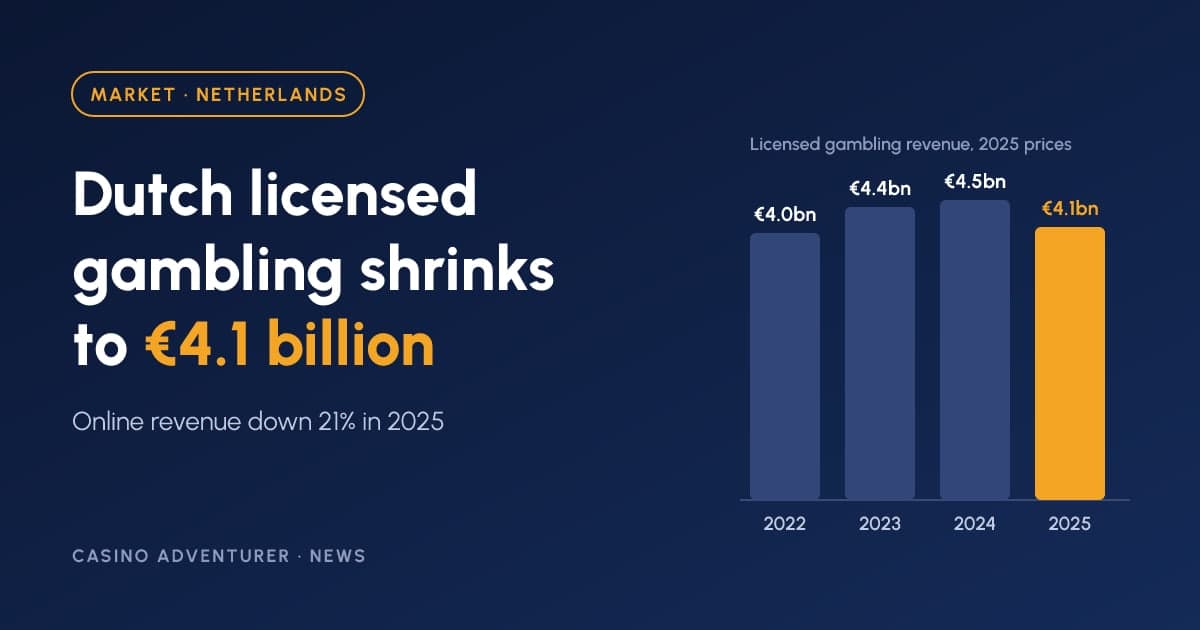
Licensed Dutch gambling took €4.1 billion in 2025 with online down 21%, and licensed sites held 59% of online spending in early 2026.
Key facts
- The Netherlands Gambling Authority (KSA) puts the licensed Dutch gambling market at €4.1 billion in gross gaming revenue for 2025, down from an inflation-adjusted €4.5 billion in 2024.
- Licensed online revenue was €1.20 billion, down 21%. Online casino games fell 18.2% and online betting 30.2%.
- The KSA links the fall to deposit caps introduced in October 2024, a higher gambling tax and the end of the boost from the men's Euro 2024.
- From January to June 2026, licensed online revenue was €670 million, about 11% more than in the second half of 2025.
- The KSA estimates that licensed sites took 59% of online gambling revenue in that period, while about 94% of people who gamble online use licensed sites only.
How big is the Dutch gambling market now?
The Netherlands Gambling Authority (Kansspelautoriteit, or KSA) published two reports on 29 October 2026. Its yearly market scan for 2025 covers the licensed gambling market, online and land-based.
The second, a half-yearly monitoring report, covers online gambling from January to June 2026, including an estimate of how much goes to unlicensed sites.
The scan measures size in gross gaming revenue: stakes minus prizes paid out. On that measure the licensed Dutch gambling market took €4.1 billion in 2025, against €4.5 billion in 2024 once that year is adjusted to 2025 prices.
Most of the drop came online. Licensed online revenue was €1.20 billion, down 21% from €1.52 billion, while land-based casino gaming, arcade and bar machines included, fell 1.0% and lotteries 1.8%. In the table, the arcades and bar machines row is our own sum of the two figures the KSA gives: €562 million and €113 million in 2024, €539 million and €104 million in 2025.
Sector | 2024, in 2025 prices | 2025 | Change |
|---|---|---|---|
Online casino games | €1.16 billion | €947 million | Down 18.2% |
Online sports and horse betting | €364 million | €254 million | Down 30.2% |
Holland Casino | €664 million | €683 million | Up 2.8% |
Arcades and bar machines | €675 million | €643 million | Down 4.7% |
Land-based betting | €80 million | €86 million | Up 8.5% |
Dutch adults still lose less to licensed gambling than the EU average. The KSA puts the loss at €282 per adult in 2025, against €369 across the EU once income and purchasing power are taken into account, using figures from the data firm H2 Gambling Capital.
Why did licensed online revenue fall?
The KSA points first to the player-protection rules in force since 1 October 2024. A licensed site must cap a player's net deposits at €700 a month, or €300 for players aged 18 to 23, and can raise the cap only when the player shows they can afford it.
Gambling tax rose as well, from 30.5% in 2024 to 34.2% in 2025. It went up again to 37.8% on 1 January 2026.
Tax receipts held up because of the higher rate. Gambling tax brought in €1.05 billion in 2025, against €1.06 billion in 2024 after inflation.
Sport played a part too. The men's Euro 2024 football championship lifted betting that summer. Since 1 July 2025 online operators may not sponsor sports clubs, matches or athletes, a ban the KSA says may also have weighed on revenue.
Land-based betting went the other way, up 8.5%. The KSA suggests the rules may explain the gap: duty-of-care rules are less strict for land-based betting, and it has no check against Cruks, the national self-exclusion register.
Has online revenue recovered in 2026?
Partly. The monitoring report puts licensed online revenue at €670 million for January to June 2026, about 11% more than the €602 million of the second half of 2025, or around €110 million a month.
Casino games against the house made up 73% of that, about €492 million, and sports betting 24%, about €163 million. Betting's share was 20% six months earlier, and the KSA names the men's World Cup, which began in June, as a possible reason.
Accounts grew faster than players. Licensed sites averaged 1.48 million active accounts a month, up from 1.38 million, and 563,000 new accounts were opened in the six months.
The number of people gambling did not rise with them. The KSA estimates that about 820,000 people gambled at licensed sites at some point in the half year, and about 490,000 in an average month, both slightly below the previous period.
The regulator reads this as more people using several accounts, possibly to get around the deposit cap, which applies to each account.
Losses per person rose. The KSA estimates that a person who gambles at licensed sites lost €137 a month on average in early 2026, up from €121 in the second half of 2025 but below the €160 of early 2024, before the deposit caps. It stresses that these are estimates.
What does 59% channelisation mean?
Channelisation is the share of gambling that goes to licensed operators. The KSA measures it in two ways: by people, using a panel of about 6,000 people in the Netherlands whose devices log the sites they visit, and by revenue, estimated from search volumes for gambling sites.
By people, the rate is high. About 94% of people who gamble online do so only at licensed sites, or 97% if people who use both kinds of site count as licensed.
In an average month of early 2026 that meant about 480,000 people at licensed sites only, 10,000 at both and 20,000 at unlicensed sites only.
By revenue, the rate is far lower. The KSA estimates that licensed sites took 59% of online gambling revenue from January to June 2026, up from 54% in the second half of 2025. On our arithmetic, that leaves about 41% with sites that hold no Dutch licence.
The KSA reads the gap as a sign that people who gamble at unlicensed sites lose considerably more on average. It found no sign that the stricter rules had lowered channelisation.
The revenue figure comes with a caveat. The KSA has changed its method: it now leaves out sites it believes inflate their own search volume, and its monitoring report shows revenue estimates only from summer 2025.
Last year's report, on the old method, put revenue channelisation at 49% for the first half of 2025, with unlicensed sites (€617 million) slightly ahead of licensed ones (€600 million). The two series are not directly comparable.
Some trade reports have presented the 59% as a figure for 2025. The KSA gives it for the first half of 2026.
What do the figures mean for players?
Protection reaches only players at licensed operators. Licensed sites, arcades and Holland Casino must check Cruks, the self-exclusion register at gokstop.nl, before letting anyone play.
Cruks held 120,200 registrations on 31 July 2026. The total grew by about 2,000 a month in the first half of 2026, but by only 400 in June. Specialist addiction services treated 3,108 people for gambling as their main problem in 2025, 14% more than in 2024.
Licensed operators also advertised less. Nielsen counted about 50,000 of their online ads a month in early 2026, down 33% from 75,000 in the second half of 2025.
More rules are on the way. In June the government set out plans for a near-total ban on online gambling ads and one deposit limit across all sites, as we reported on the Dutch ad ban and new safeguards.
The KSA also keeps fining unlicensed operators. A week before these reports it fined Instantcasino's operator a record €37 million.
The difference between 94% and 59% suggests that a small group of players at unlicensed sites, outside the Dutch deposit caps and the Cruks check, accounts for a large share of the money lost. Wherever you play, check the site's licence with your own regulator before signing up.
Frequently Asked Questions
The KSA puts licensed gross gaming revenue, stakes minus prizes, at €4.1 billion in 2025, down from €4.5 billion in 2024 in 2025 prices.
Online gambling made up €1.20 billion of that, down 21% on 2024.
By people, about 94% of those who gamble online use only licensed sites, or 97% depending on how people who use both are counted.
By revenue, the KSA estimates that licensed sites took 59% of online gambling revenue from January to June 2026, up from 54% in the second half of 2025.
Only at sites licensed by the KSA. The licensing system for online gambling opened on 1 October 2021.
In June 2026, 31 companies held an online gambling licence and 28 of them were operating. The KSA's website lists every licence holder.
Since 1 October 2024, licensed sites cap net deposits at €700 a month for players aged 24 and over and €300 a month for players aged 18 to 23. A site can raise the cap only when a player shows they can afford it.
The cap applies to each account, which the KSA thinks may be why some players now use several accounts.
Paolo Pellegrini is Casino Adventurer's news editor, based in Rome, where he was born and raised. He covers the stories shaping the online gambling industry, from new regulations and tax changes to market openings and major deals, and always explains what they mean for players. He's naturally curious and starts every morning with the news and a strong espresso. Outside work, he's a lifelong AS Roma fan and loves cooking for friends on Sundays.
More iGaming News
All casino news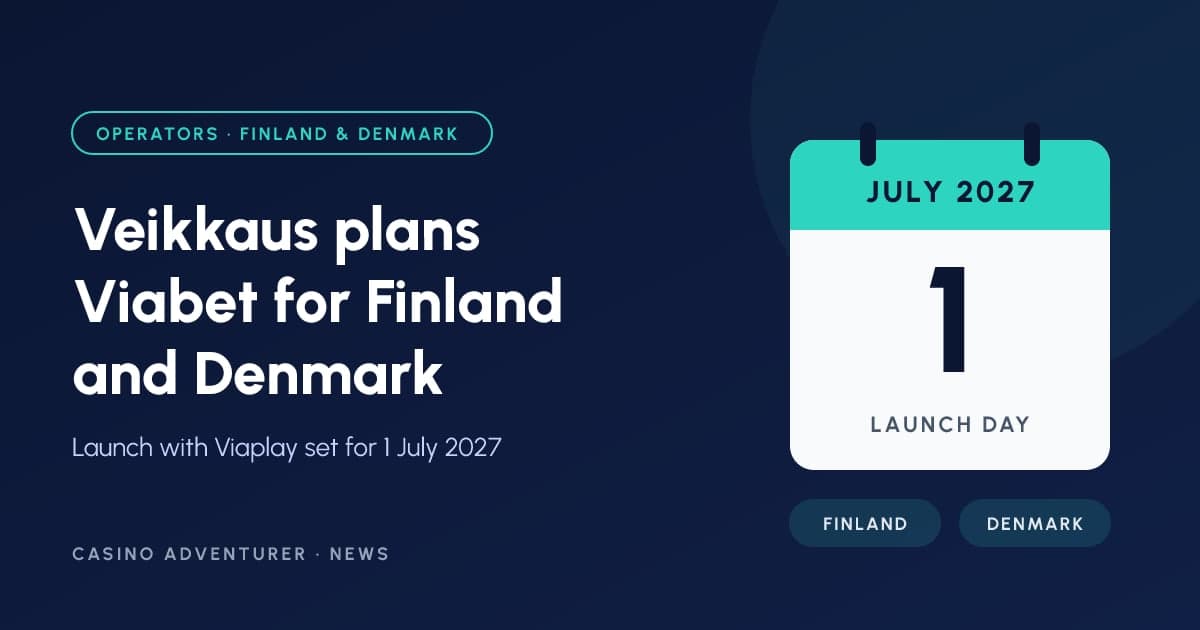
Veikkaus to Launch Viabet in Finland and Denmark With Viaplay
Veikkaus will launch Viabet with Viaplay in Finland and Denmark on 1 July 2027, its first gambling brand abroad, as Finland's market opens.
Federal Court Orders The Star to Pay $260 Million in AUSTRAC Case
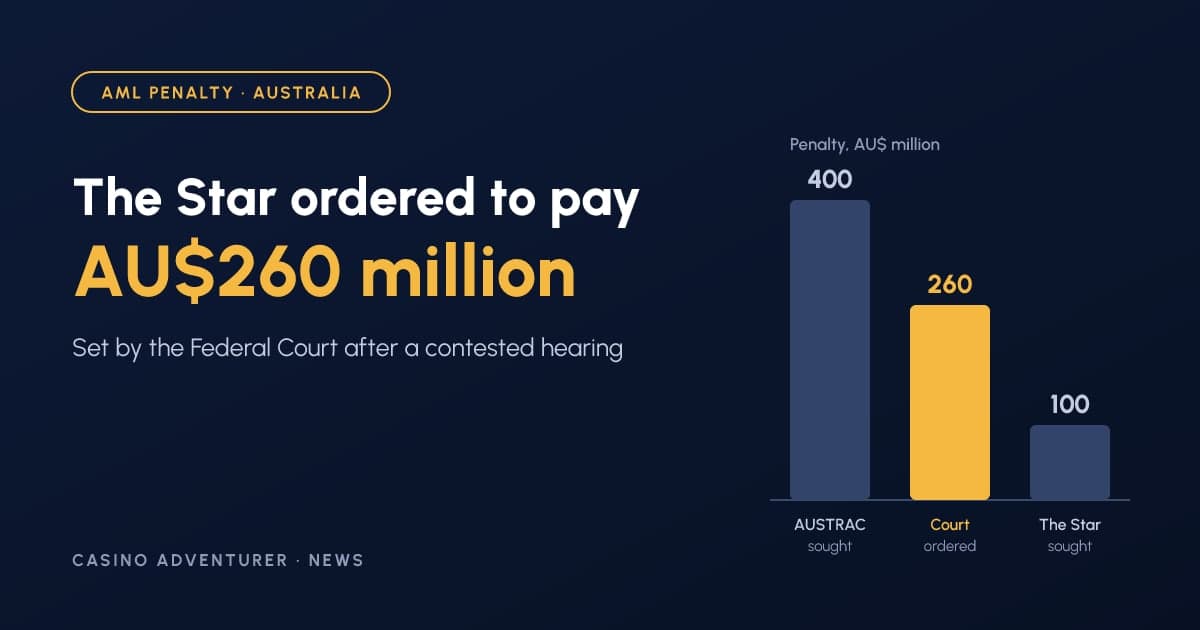
The Federal Court ordered The Star to pay AU$260 million for anti-money laundering failures, the first AUSTRAC penalty set after a contest.
Spain Requires Gamblers to Deposit and Withdraw in Their Own Name
Spanish-licensed gambling sites must check every payment method is in the player's own name, and older accounts have until 28 April 2027.