













Malta Replaces Flat 5% Gaming Tax With 15% and 10% Rates From 1 October
Malta swaps its flat 5% gaming tax for 15% and 10% rates from 1 October 2026 and narrows its gambling VAT exemption. Who pays and what changes.
What Changes on 1 October
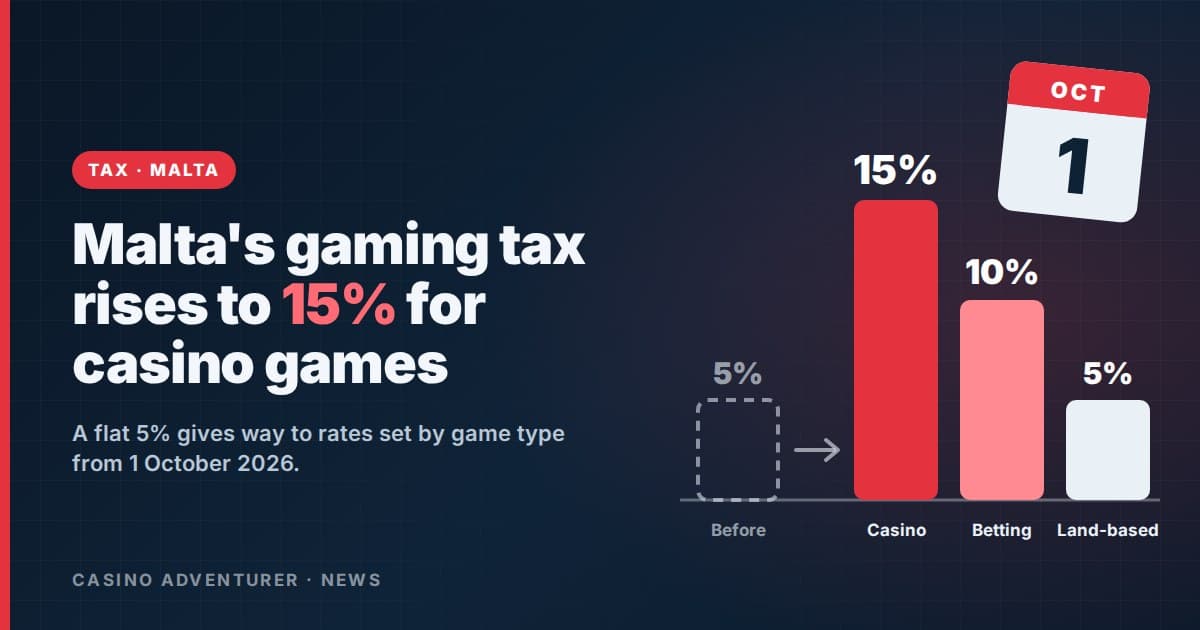
Malta will replace its flat 5% gaming tax and separate gaming device levy with a single tax on gaming revenue from 1 October 2026, with rates that depend on the type of game.
Casino-style games decided by a random number generator will be taxed at 15%, while betting, peer-to-peer games and controlled skill games move to 10%. Land-based gaming premises and junkets stay at 5%.
The changes were set out in Legal Notice 84 of 2026 and Legal Notice 86 of 2026, published on 1 April. The Malta Gaming Authority and the Malta Tax and Customs Administration announced them jointly the next day, giving the industry six months to prepare.
The two authorities said the changes answer industry feedback and deliver on a 2026 Budget pledge to keep the sector sustainable and competitive.
Malta's New Gaming Tax Rates at a Glance
Service | New rate |
|---|---|
Type 1: RNG games against the house, such as slots, roulette, lotteries and virtual sports | 15% |
Type 2: betting against the house at operator-set odds, such as sports betting | 10% |
Type 3: games where players compete against each other and the operator takes a commission, for example poker rooms, bingo and exchanges | 10% |
Type 4: controlled skill games | 10% |
Gaming inside controlled gaming premises | 5% |
Junkets and junket events | 5% |
PwC Malta describes the regime as a revenue-based tax on aggregate gaming revenue. Taxing revenue rather than stakes is the norm across most of Europe, with Germany a notable exception.
The tax is calculated monthly. As before, overpayments are not refunded and earn no interest, but they can now only be offset against gaming tax due in later periods.
Studios also face a higher charge. Holders of a critical gaming supply authorisation that use premises for filming or broadcasting will pay a fixed €3,000 a year in advance, up from €500, and the levy now applies regardless of other payments.
Who Pays: The Player Residence Test
The new tax applies only to gaming services provided in Malta. It does not reach revenue that Malta-licensed operators earn from players in other countries.
Online, the deciding factor is the player's connection to Malta: being established there, having a permanent address there or usually living there. Where the player happens to be when placing a bet is not the test.
That distinction matters because many Malta-licensed online operators serve mainly international markets. For them, the headline 15% rate applies only to revenue from their Maltese customers.
The MGA also gains the power to grant reliefs, reductions, credits or set-offs through binding instruments without ministerial approval, and a corporate group holding a group licence is treated as a single person for gaming tax.
VAT: A Narrower Exemption for Gambling
A second change takes effect on the same day. Under Legal Notice 86, the VAT exemption for gambling will cover only low-risk games, occasional junket events, and gambling facilities at sporting venues that can only be used at the venue.
Everything else, including sports betting and live casino, becomes taxable for Maltese VAT in principle, according to Deloitte Malta. Malta's standard VAT rate is 18%.
Operators gain the right to recover eligible input VAT. The tax administration issued VAT guidelines on 6 April 2026, including guidance on streamed and virtual activities relevant to live casino, and both authorities have promised further implementation guidance.
What Operators and Players Should Expect
For operators with Maltese customers, the combined effect is a higher tax take on casino products and a new VAT cost on most supplies, partly offset by input VAT recovery. Casino-focused businesses face the largest increase, since their rate triples from 5% to 15%.
The tax falls on operators' gaming revenue, not on player winnings. Neither the MGA nor operators have said how the change will affect the products offered to Maltese players.
The reform lands on the same day as a separate 25% increase in UK Gambling Commission licence fees, adding to cost pressure on companies active in both markets.
No official estimate of the revenue impact or the number of affected licensees has been published.
Frequently Asked Questions
The new rates apply from 1 October 2026 under Legal Notice 84 of 2026. The VAT changes in Legal Notice 86 of 2026 start on the same day.
No. The tax applies only to gaming services provided in Malta. For online gaming, it covers revenue from players who are established in Malta, have a permanent address there or usually live there.
No. The tax is charged to operators on their aggregate gaming revenue. It is not a tax on individual player winnings.
It is abolished and folded into the new revenue-based tax. A separate levy on filming and broadcast studios rises to €3,000 a year.
Paolo Pellegrini is Casino Adventurer's news editor, based in Rome, where he was born and raised. He covers the stories shaping the online gambling industry, from new regulations and tax changes to market openings and major deals, and always explains what they mean for players. He's naturally curious and starts every morning with the news and a strong espresso. Outside work, he's a lifelong AS Roma fan and loves cooking for friends on Sundays.
More iGaming News
Read more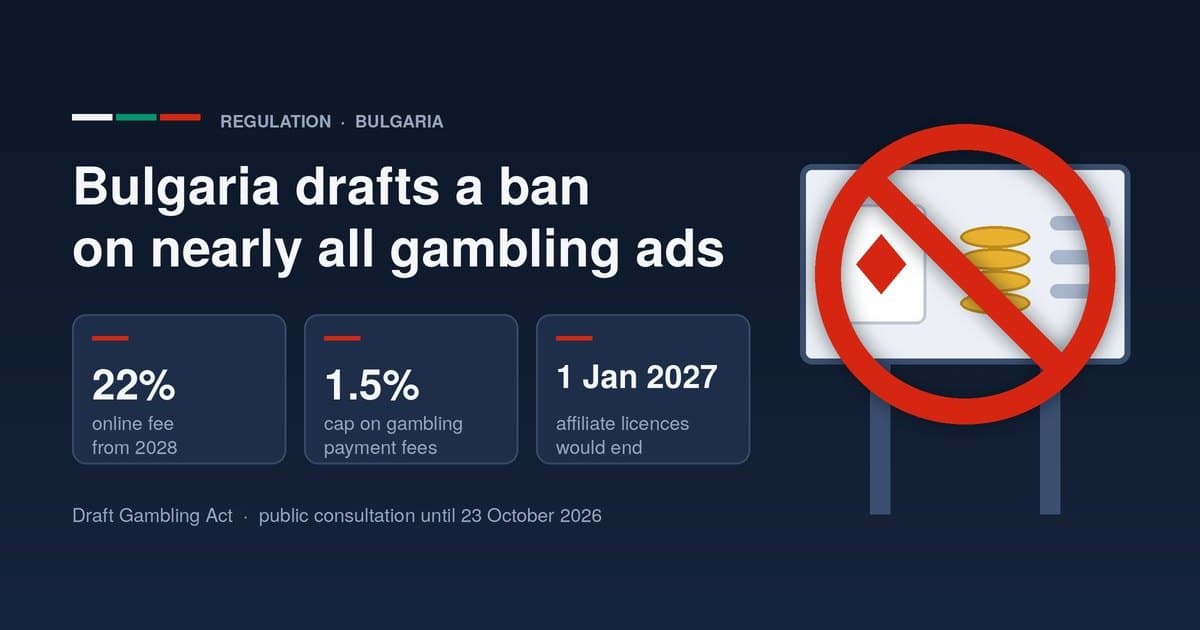
Bulgaria Drafts Near-Total Gambling Ad Ban, Higher Online Fees and End of Affiliate Licences
Bulgaria's draft Gambling Act bans nearly all gambling ads, ends affiliate licences in 2027 and lifts online fees to 22%. Comments close 23 October.
Leaked CGA Files Show Stake Operator Got Curaçao Licence Before Ownership Checks Finished
Leaked CGA files show Medium Rare N.V., which runs Stake, got a conditional Curaçao licence in June 2025 while its ownership was still under review.

Gaming1 Buys Carousel Operator Pac-Man NV to Grow Its Belgian Online Casino Reach
Gaming1 has bought Pac-Man NV, taking over Carousel's Belgian online casino licence and Harelbeke gaming hall. What the deal means for players.