








Bulgaria Drafts Near-Total Gambling Ad Ban, Higher Online Fees and End of Affiliate Licences
Bulgaria's draft Gambling Act bans nearly all gambling ads, ends affiliate licences in 2027 and lifts online fees to 22%. Comments close 23 October.
What Bulgaria Is Proposing
Bulgaria's Ministry of Finance published a draft law amending the Gambling Act for public consultation on 23 September 2026. Prime Minister Rumen Radev presented the package at that day's government meeting.
The draft would ban almost all gambling advertising, end the licensing regime for gambling affiliates, raise the fee paid by online betting operators and cap the fees banks and payment firms keep from gambling transactions.
The Public Consultation Portal lists two aims for the bill: more state revenue from gambling and less gambling addiction. Public comments are open until 23 October 2026.
"We are in practice introducing a complete ban on gambling advertising," Radev said, according to the government press office. He added that the government does not want aggressive advertising reaching young people and children.
Area | Proposed change |
|---|---|
Advertising | Near-total ban in every channel, with a sports sponsorship exception |
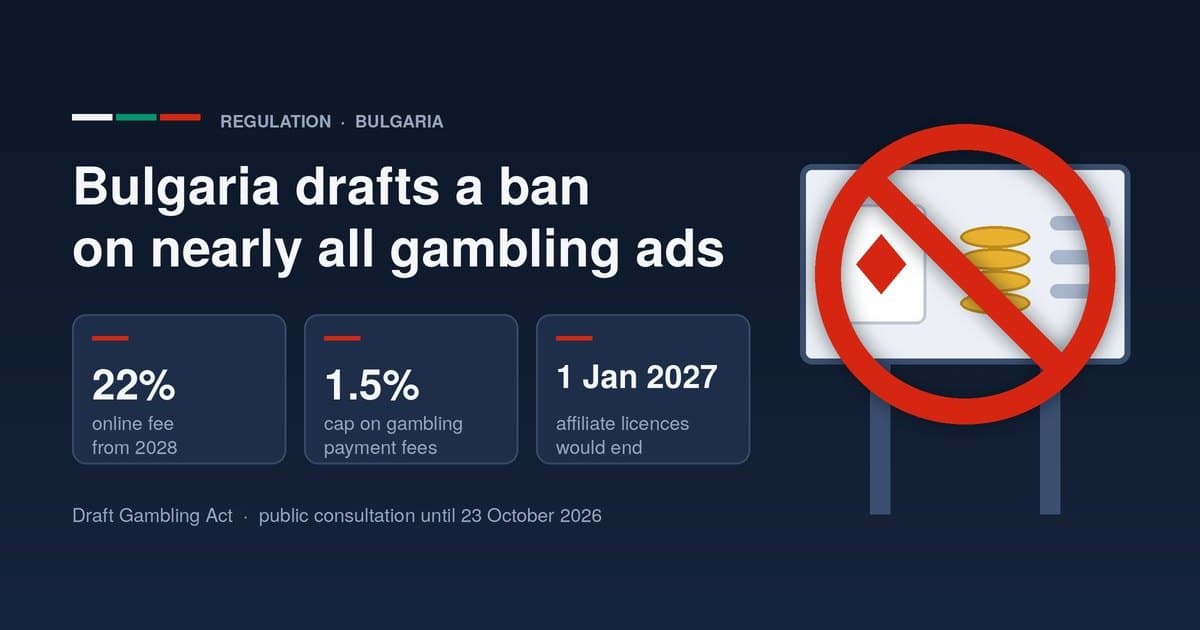
Affiliates | All affiliate licences end on 1 January 2027 |
Online betting fee | 20% today, 21% in 2027, 22% from 2028 |
Minimum online fee | €100,000 per month |
Payment providers | Fees above 1.5% of a gambling transaction go to the state |
Foreign licensees | Must register their financial activity in Bulgaria |
Casinos and gaming halls | Gaming equipment linked to the National Revenue Agency in real time |
None of this is law yet. The measures could still change after the consultation and during the debate in parliament.
How the Advertising Ban Would Work
The draft prohibits advertising of gambling games, operators and their trademarks regardless of format or place. SBC News reports that this covers TV, radio, print, outdoor, online, social media, apps and streaming services.
Operators could still publish the information needed to take part in their games on their own websites and at their licensed premises.
Sports sponsorship is the main exception. Licensed operators could keep sponsoring clubs, federations and leagues, with logos on kits, equipment, halls and stadiums, but not on products meant for under-18s.
Broadcasts of sponsored events could not add digital overlays of a gambling brand. Only branding physically present at the venue could appear on screen.
Casino and gaming hall facades would face tight limits. Signs could cover no more than 20% of the front and 50 square metres, at least a tenth of that space would need an addiction-risk warning, and illuminated or moving displays would be banned.
Radev said the bright facades had changed how Bulgarian towns look, telling ministers they had come to resemble Las Vegas.
The plan follows 2024 restrictions on TV, radio and online advertising. According to Yogonet, the government's impact assessment found that promotion moved onto billboards and posters instead, and that young people and people already experiencing gambling problems were still not protected well enough.
What It Means for Affiliates
The draft would terminate every affiliate licence from 1 January 2027, SBC News reports. That would close a licensing route that only opened on 1 August 2026.
Under that route, affiliates pay a fixed €6,000 a year plus 10% of their performance-based commission. The Ministry of Finance had expected it to raise about €100 million in 2026 and €150 million in 2027.
Affiliates are pushing back on the consultation portal. A licensed Bulgarian affiliate argues that scrapping the regime after five months, with no transition period, undermines legal certainty and removes revenue the state was counting on.
Several comments also raise channelisation. Their point is that people who look for gambling information will keep looking, and that sites based outside Bulgaria may steer them toward unlicensed operators.
For players, the change would mean fewer Bulgarian-regulated sites comparing licensed operators, their terms and their payment options.
Higher Fees and a 1.5% Payment Cap
Online betting operators currently pay a variable fee of 20% on the difference between bets received and winnings paid. The draft raises it to 21% in 2027 and 22% from 2028, with a minimum of €100,000 a month.
Radev said part of the extra online revenue would go to sport and education. Casinos and gaming halls would be taxed on their real financial result, and all gaming equipment would have to report to the National Revenue Agency in real time.
Foreign operators with a Bulgarian licence would have to register their financial activity in Bulgaria, so that income earned from Bulgarian players is reported and taxed there.
The most unusual measure targets payments. Banks, payment institutions and e-money firms could keep fees of up to 1.5% on gambling deposits and winnings payouts, and anything above that would go to the state budget.
SBC News gives an example: on a €1,000 deposit carrying a €30 fee, the provider would keep €15 and pass €15 to the state. Providers would also file monthly declarations.
SBC News describes this as a novel approach for an EU market. One likely effect is that gambling payment fees fall toward 1.5%, which would lower costs for players who pay them.
What Happens Next
Comments can be sent until 23 October through Bulgaria's Public Consultation Portal, by email to the Ministry of Finance's Tax Policy Directorate, through the state e-delivery system or by post.
After the consultation, the government adopts a final text and sends it to the National Assembly. Radev's Progressive Bulgaria holds a parliamentary majority after its April election win, so the bill is expected to pass with wide support.
Opposition parties also want tougher rules. Earlier in September, Democratic Bulgaria and We Continue the Change called for changes to the law and criticised weak enforcement of the 2024 restrictions.
Some submissions raise EU law questions, including whether a general ban on promoting gambling must first be notified to the European Commission. How the ministry answers these points will shape the final text.
For players in Bulgaria, licensed gambling sites would remain available but far less visible. Anyone who wants to take a break can join the Register of Vulnerable Persons, the national self-exclusion list kept by the National Revenue Agency.
Frequently Asked Questions
No. The Ministry of Finance published it as a draft on 23 September 2026, and public consultation runs until 23 October 2026.
The Council of Ministers and then the National Assembly must still approve it, and the text can change along the way.
Yes, within limits. Licensed operators could keep sponsoring sports clubs, federations and leagues, with logos on kits, equipment and venues, but not on products for under-18s.
Broadcasts of sponsored events could not add digital overlays of gambling brands.
All affiliate licences would end on 1 January 2027. The affiliate licensing route only started on 1 August 2026, and affiliates are among the most vocal critics in the consultation.
Banks, payment institutions and e-money firms could keep fees of up to 1.5% of each gambling deposit or winnings payout. Any fee above that level would go to the state budget, which could push payment fees down.
The variable fee on online betting would rise from 20% to 21% in 2027 and to 22% from 2028, calculated on bets received minus winnings paid. The draft also sets a minimum of €100,000 per month.
Paolo Pellegrini is Casino Adventurer's news editor, based in Rome, where he was born and raised. He covers the stories shaping the online gambling industry, from new regulations and tax changes to market openings and major deals, and always explains what they mean for players. He's naturally curious and starts every morning with the news and a strong espresso. Outside work, he's a lifelong AS Roma fan and loves cooking for friends on Sundays.
More iGaming News
Read more
Leaked CGA Files Show Stake Operator Got Curaçao Licence Before Ownership Checks Finished
Leaked CGA files show Medium Rare N.V., which runs Stake, got a conditional Curaçao licence in June 2025 while its ownership was still under review.
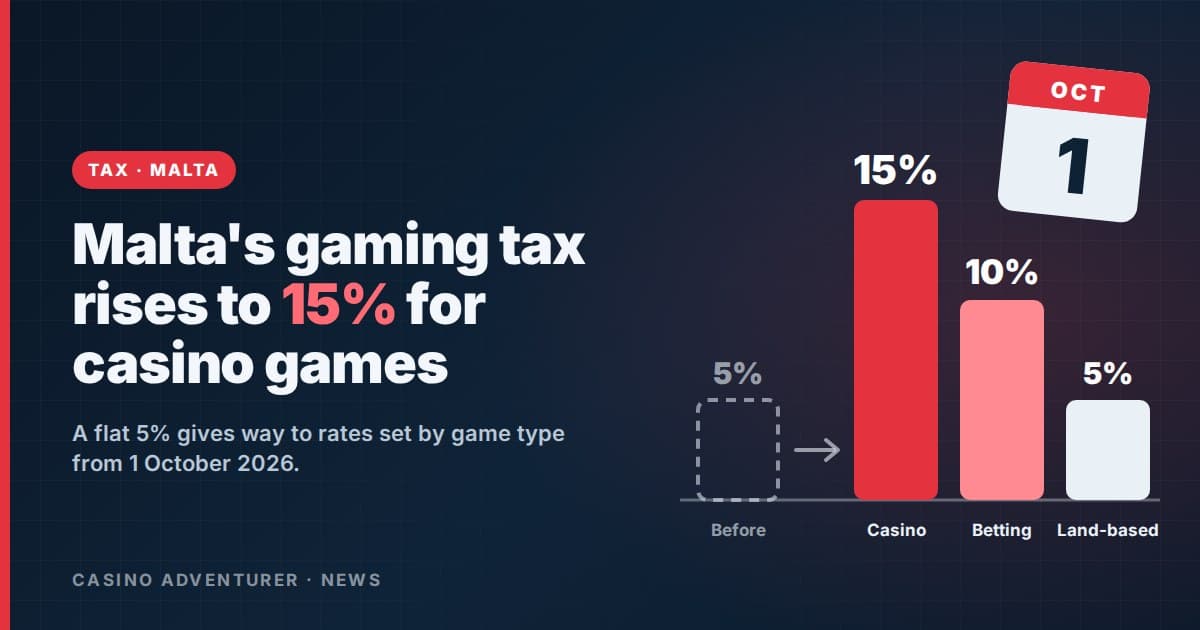
Malta Replaces Flat 5% Gaming Tax With 15% and 10% Rates From 1 October
Malta swaps its flat 5% gaming tax for 15% and 10% rates from 1 October 2026 and narrows its gambling VAT exemption. Who pays and what changes.
Gaming1 Buys Carousel Operator Pac-Man NV to Grow Its Belgian Online Casino Reach
Gaming1 has bought Pac-Man NV, taking over Carousel's Belgian online casino licence and Harelbeke gaming hall. What the deal means for players.