

Request Network Brings Pre-Transaction Wallet Screening to iGaming Crypto Payments

Request Network launched cross-chain crypto payments with pre-transaction wallet screening for iGaming operators in June 2026, targeting fraud and compliance gaps.
A Long-Standing Gap in iGaming Crypto Infrastructure
The iGaming sector was among the earliest industries to adopt cryptocurrency payments at scale. Despite that early lead, the compliance and technical infrastructure supporting those payments has lagged considerably behind the volume of transactions flowing through it. Operators have long faced a fragmented landscape of crypto processors, each with limited reach, inconsistent risk policies, and custody arrangements that created real counterparty exposure.
On 1 June 2026, Request Network, a Web3 payment protocol operating since 2017, announced a set of new features aimed directly at closing those gaps. The announcement, made from Zug, Switzerland, positions the protocol as a single integration point for stablecoin collection and disbursement across multiple blockchain networks.
The timing reflects growing pressure on iGaming operators to demonstrate cleaner payment flows. Regulators across several markets have been tightening expectations around the provenance of funds, and the absence of robust pre-transaction screening has left many platforms exposed to asset freezing and wallet blacklisting.
Cross-Chain Payments Through a Single Integration
One of the core problems the update addresses is the fragmentation of player holdings across different blockchains and tokens. Previously, an operator wanting to accept a wide range of crypto assets had to either maintain wallets on every relevant chain or rely on centralised payment service providers, each carrying their own continuity risks and coverage limitations.
Request Network's updated protocol allows operators to collect payments through a single wallet integration while players pay using whichever chain and token they hold. The bridging and swapping required to reconcile those differences happens behind the scenes, without either party needing visibility into the other's chain preference.
According to the company, the integration now covers seven blockchain networks: Ethereum, BNB, Tron, Base, Polygon, Arbitrum, and Optimism. The protocol claims this gives operators access to roughly 95 percent of the global stablecoin supply through one connection, a figure that, if accurate, would represent a meaningful consolidation of what has historically been a very scattered market.
For players, the practical change is a simplified deposit experience. The previous process often required bridging assets, holding gas tokens, and running test transactions to verify wallet addresses. The new interface is described as a single gasless transaction with security features designed to prevent interaction with malicious smart contracts.
Pre-Transaction Wallet Screening and the Compliance Argument
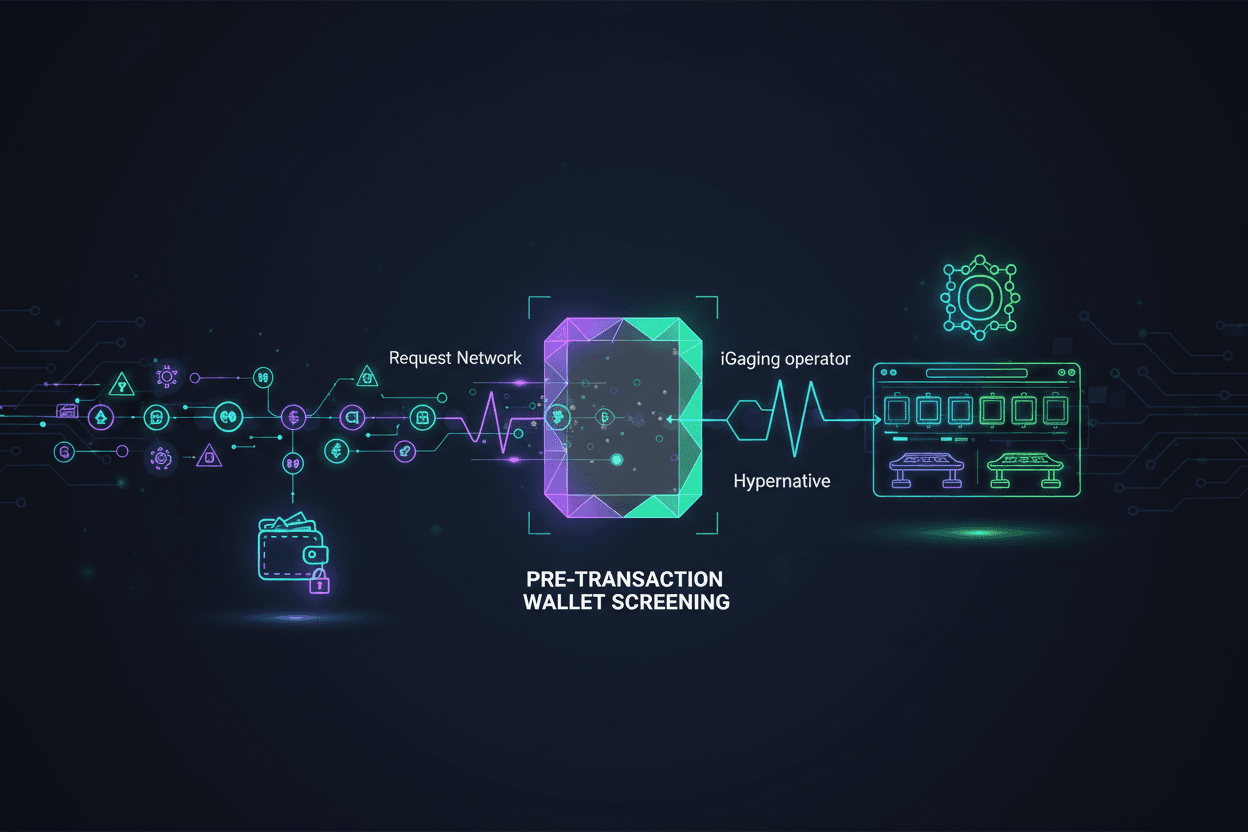
The most operationally significant feature in the update is the introduction of pre-transaction wallet screening, delivered through a native integration with Hypernative, a blockchain risk monitoring firm. The distinction from existing approaches is important: most wallet screening in the iGaming sector currently happens after a transaction has settled, meaning operators only discover a problem once flagged funds have already reached their wallets.
That post-settlement discovery creates a difficult legal position. Operators holding flagged assets can face lengthy procedures to release frozen funds, and in some jurisdictions the reputational and regulatory consequences extend beyond the financial loss itself.
Request Network's approach inverts that sequence. A sending wallet is screened before any funds move, and a deposit is only permitted if the wallet passes the policy in place. The protocol also stores screening results, giving operators an auditable record they can use to demonstrate compliance if the provenance of funds is later questioned.
Gal Sagie, CEO of Hypernative, described the gap the feature addresses by noting that "the compliance infrastructure needed to make it work at scale has lagged" and that pre-transaction screening means operators can "accept funds with confidence, not just optimism." Hypernative reportedly monitors over 100 billion dollars in digital assets across more than 70 chains for its client base.
Why the Timing Matters for iGaming Operators
The release comes at a point when crypto payment volumes in iGaming are growing faster than the regulatory frameworks designed to govern them. Several licensed markets in Europe and beyond have been updating their anti-money laundering requirements, and the question of how to apply those requirements to on-chain transactions has remained technically unresolved for most operators.
Operators accepting crypto have generally had two options: work with a fragmented set of smaller processors, or rely on larger centralised providers whose risk appetites and regulatory coverage can shift without notice. Both approaches carry continuity risk, and neither has offered a clean answer to the compliance question.
A decentralised, permissionless protocol with built-in screening represents a structurally different answer. Whether it gains broad adoption will depend on how operators weigh the integration effort against the compliance benefit, and on how regulators in key markets respond to on-chain audit trails as evidence of due diligence.
The Broader Context: Stablecoins as the Operational Default
The focus on stablecoins rather than volatile assets like Bitcoin or Ethereum reflects a broader shift in how iGaming platforms are approaching crypto. Stablecoins such as USDT and USDC have become the preferred medium for operators because they remove the exchange rate risk that complicates accounting and player balance management when prices move sharply.
The Lightning Network and other layer-two solutions have made Bitcoin more viable for smaller, faster transactions, but stablecoins have emerged as the practical default for day-to-day deposit and withdrawal flows. Request Network's architecture is built around that reality, prioritising stablecoin settlement while maintaining flexibility for other assets.
The broader infrastructure question, of how to make crypto payments both fast and compliant at scale, has been a recurring theme across the iGaming sector in 2026. This update from Request Network is one of the more concrete technical responses to that question seen so far this year, though the industry will need time to assess how it performs under real operational conditions.
What Operators and the Industry Should Watch Next
For iGaming operators currently evaluating their crypto payment stack, the key questions following this announcement are practical ones. How straightforward is the integration process? How does the screening policy interact with existing KYC and AML workflows? And how does the cost structure compare to existing processor arrangements?
The stored screening results feature is worth particular attention from a compliance perspective. As regulators in markets such as the UK, Malta, and Ireland continue to develop their expectations around crypto transaction monitoring, having an auditable pre-transaction record could become a meaningful differentiator for licensed operators.
The announcement also signals a wider trend: the infrastructure layer of iGaming payments is attracting serious technical investment. For years, the conversation around crypto in gambling focused almost entirely on player-facing features. The shift toward back-end compliance tooling suggests the industry is maturing in how it thinks about the risks that come with operating at scale on public blockchains.
Whether Request Network becomes a standard integration across the sector or remains one option among several will depend on adoption over the coming months. What the June 2026 update makes clear is that the gap between crypto payment ambition and compliance reality in iGaming is no longer being treated as an unsolvable problem.

Daniel Kovacs is a seasoned online casino reviewer known for his analytical approach and no-nonsense writing style. With a background in digital marketing and a long-standing interest in probability and game mechanics, he built his reputation by breaking down complex casino systems into clear, practical insights for everyday players. He started his career freelancing for niche gambling blogs before launching his own review platform, where he focuses on transparency—testing bonuses, verifying payout speeds, and digging into terms that most players overlook. Daniel is particularly respected for his deep dives into slot RTPs, customer support responsiveness, and real user experiences.
More iGaming News
Read more
Netherlands Tightens Online Gambling Rules with Near-Total Ad Ban and Stricter Safeguards
The Dutch government is introducing sweeping new gambling rules, including a near-total ad ban, bonus restrictions, and a raised minimum age for online play.

MiCA's July 2026 Deadline Forces Crypto Casinos to Choose: Comply or Exit the EU
The EU's MiCA grandfathering period ends July 1, 2026, forcing crypto-accepting online casinos to obtain full CASP authorization or stop serving European players.

Finland Opens Its Gambling Market to Private Operators as Licence Applications Surge
Finland's shift away from its gambling monopoly is drawing strong industry interest, with 50 licence applications already filed ahead of the 2027 market opening.